


Families come into Mike Kelly Toyota of Uniontown already sold on a Toyota three-row and stuck on which one, and we understand why. Both seat seven or eight. Both run the same 2.4L turbo gas engine. Both tow the same 5,000 pounds. Both carry the same warranty, down to the hybrid battery term. Both sit the same eight inches off the ground.
2026 Toyota Grand Highlander vs. 2026 Toyota Highlander
What actually separates them is short: about four inches of length, a meaningful jump in cargo room, one generation of driver-assist technology, one powertrain that exists on only one side, and a price story that runs in two directions at once depending on how you line the lineups up.
Here is all of it, told straight. Where the standard Highlander is the smarter buy, we say so out loud instead of burying it at the bottom.
At a glance
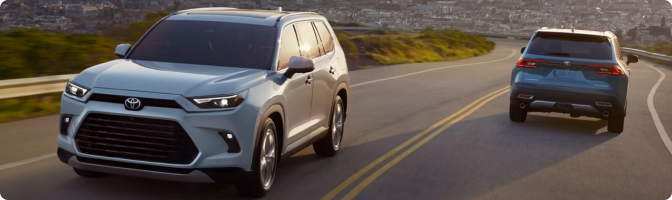
| Feature | 2026 Grand Highlander | 2026 Highlander |
|---|---|---|
| Seating | 7 or 8 | 7 or 8 |
| Gas engine | 2.4L 4-cylinder turbo, 265 hp / 310 lb-ft | 2.4L 4-cylinder turbo, 265 hp / 310 lb-ft |
| Hybrid | Yes | Yes |
| Hybrid MAX available | Yes, 362 net combined hp | No |
| Cargo behind the third row | 20.6 cu ft | 16.0 cu ft |
| Maximum cargo | 97.5 cu ft | 84.3 cu ft |
| Length | 201.4 in | 194.9 / 197.4 in |
| Wheelbase | 116.1 in | 112.2 in |
| Ground clearance | 8.0 in | 8 in |
| Max gas towing | 5,000 lb | Up to 5,000 lb |
| Driver-assist suite | Toyota Safety Sense 3.0 standard | Toyota Safety Sense 2.5+ standard |
| Government crash rating | Five stars overall | Five stars overall |
| Lowest starting MSRP | $41,660 (LE FWD) | $45,570 (XLE AWD) |
| Grade count in the walk below | 10 | 7 |
Prices shown are starting MSRP at launch, excluding destination.
What the two SUVs share

A lot of this comparison is a tie. Knowing which parts tie saves you from shopping on things that will not decide anything.
The gas engine is the same physical engine with the same output, and the tow rating is the same number. The warranty is identical across all five terms, including the hybrid system and hybrid battery coverage most people assume must differ between a bigger and a smaller vehicle. Both were rated five stars overall in government crash testing. Both put the same 12.3-inch screen in front of you, with wireless Apple CarPlay and Android Auto working out of the box.
| What ties | Both models |
|---|---|
| Seating capacity | 7 or 8, depending on second-row configuration |
| Gas engine and output | 2.4L 4-cylinder turbo, 265 hp / 310 lb-ft |
| Max gas towing | 5,000 lb |
| Ground clearance | 8 in |
| Government crash rating | Five stars overall |
| Touchscreen | 12.3-in Toyota Audio Multimedia, wireless Apple CarPlay and Android Auto standard |
| Premium audio | 11-speaker JBL with subwoofer and amplifier |
| Blind Spot Monitor with Rear Cross-Traffic Alert | Standard |
| Front and Rear Parking Assist with Automatic Braking | Available |
| Panoramic View Monitor | Available |
What that leaves: cargo room, footprint, the driver-assist generation, the Hybrid MAX powertrain, efficiency by a small margin, and price. Those six things are the entire decision. Everything else is noise.
Space, seating and cargo
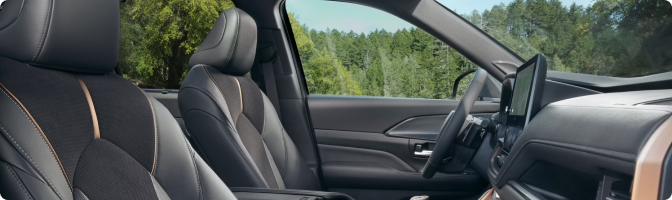
What you buy with the Grand Highlander is room behind the people. Both SUVs seat seven or eight, so capacity is not the dividing line.
Every seat up and every seat full, the Grand Highlander gives you 20.6 cubic feet behind the third row against the Highlander's 16.0. That 4.6 cubic feet is proportionally the widest gap anywhere in this comparison, roughly a 29 percent increase. It is the difference between a third row that is occupied and a cargo area that still works. Six passengers plus a Costco run, or five passengers plus a week's luggage, is where the number stops being abstract, and it is the exact scenario that sends families cross-shopping these two.
Fold the third row and the gap grows to 9.5 cubic feet: 57.9 against 48.4. Fold everything and it is 97.5 against 84.3, a 13.2 cubic-foot spread. The advantage scales, in other words. It is smallest in raw cubic feet when the car is full of people and largest when the car is empty, which matters if you bought a three-row mostly to move things rather than people.
Behind that third-row advantage sits one structural fact: the Grand Highlander runs a 116.1-inch wheelbase to the Highlander's 112.2. Those 3.9 extra inches sit between the axles, spread where the seats are, not hung off the ends as overhang.
One honest limit: we can put cargo volume in front of you, but not per-row legroom and headroom. Those two figures are not going on this page for either SUV. If third-row legroom is your deciding factor, the answer is a tape measure and a test drive, not a spec sheet. Sit in row three of both, with the second row set where your family actually keeps it. Ten minutes settles it better than any page can.
| Dimension | Grand Highlander | Highlander |
|---|---|---|
| Seating capacity | 7 or 8 | 7 or 8 |
| Cargo, behind third row | 20.6 cu ft | 16.0 cu ft |
| Cargo, behind second row | 57.9 cu ft | 48.4 cu ft |
| Cargo, maximum | 97.5 cu ft | 84.3 cu ft |
| Length | 201.4 in | 194.9 / 197.4 in |
| Width | 78.3 in (without mirrors) | 76.0 in |
| Height | 70.1 in without antenna, 72.1 in with antenna | 68.1 in |
| Wheelbase | 116.1 in | 112.2 in |
| Ground clearance | 8.0 in | 8 in |
| Curb weight | 4,290 to 4,905 lb | 4,376 to 4,595 lb |
| Gross vehicle weight rating | 6,010 to 6,340 lb | 5,970 to 6,000 lb |
| Max gas towing | 5,000 lb | Up to 5,000 lb |
| Max Hybrid MAX towing | 5,000 lb | Not offered |
| Fuel tank | 17.83 gal (gas) / 17.17 gal (hybrid and Hybrid MAX) | 17.9 / 17.1 gal |
A note on that height row: the two figures are measured to different stated bases, so we list each as its manufacturer states it rather than subtracting them into a number that would mean nothing. If garage clearance is the issue, measure your opening and check the specific vehicle on the lot. Five minutes with a tape beats a number on a page.
A note on weight: the Grand Highlander's curb-weight range runs both lower and higher than the Highlander's. Its lineup includes a lighter front-drive base grade at one end and a heavier Hybrid MAX Platinum at the other. Compare the configuration you are actually buying, not the range.
Towing is a tie, and we will not pretend otherwise: both SUVs are rated at 5,000 pounds on the gas engine, and the Grand Highlander's Hybrid MAX is rated at the same 5,000. Pulling a camper toward Ohiopyle or a pair of sleds up to Seven Springs does not decide this one. What might decide it is which one you would rather park once you get there.
Powertrains and efficiency
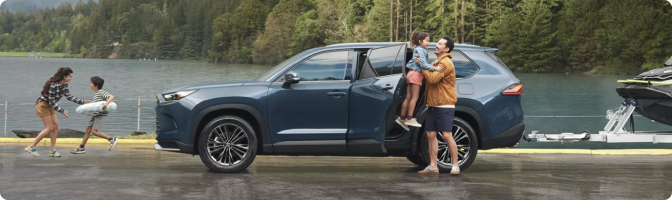
The gas engine is the same in both: a 2.4L four-cylinder turbo making 265 hp at 6,000 rpm and 310 lb-ft from 1,700 to 3,600 rpm. Same output, same character, same low-end pull. On the hills around here, that low-end pull matters more than the horsepower number does. The Grand Highlander pairs it with a Direct Shift 8-speed automatic, and the Highlander uses an 8-speed automatic as well.
Both offer a hybrid built around a 2.5L four-cylinder. In the Grand Highlander, that engine contributes 187 hp on its own, and the system is rated at 245 net combined horsepower.
One powertrain exists on only one side of this comparison. Hybrid MAX is Grand Highlander only: a 2.4L turbo hybrid making 362 net combined horsepower and 400 net combined lb-ft, through a Direct Shift 6-speed automatic and full-time electronic all-wheel drive. That is 97 more horsepower and 90 more lb-ft than the Highlander's 265 hp / 310 lb-ft gas engine. We are not going to rank the two hybrids against each other on power. The Hybrid MAX's torque peak sits between 2,000 and 3,000 rpm, which is exactly where you are when a loaded car is climbing.
Want that extra shove for merging onto US-40 with the family aboard and a trailer behind you? The Highlander lineup has no Hybrid MAX grade at any price. Hybrid MAX is also the Grand Highlander's thirstiest configuration and its most expensive, at $55,490 and $59,575 starting MSRP at launch, excluding destination, for the Limited and Platinum. Real capability, real bill.
| Powertrain detail | Grand Highlander | Highlander |
|---|---|---|
| Gas engine | 2.4L 4-cylinder turbo, 16-valve D-4S | 2.4L 4-cylinder turbo |
| Gas output | 265 hp / 310 lb-ft | 265 hp / 310 lb-ft |
| Gas transmission | Direct Shift 8-speed automatic | 8-speed automatic |
| Gas AWD system | Dynamic Torque Control AWD | AWD gas adds Multi-Terrain Select |
| Hybrid engine | 2.5L 4-cylinder (187 hp) | 2.5L 4-cylinder |
| Hybrid transmission | ECVT | Automatic |
| Hybrid AWD system | Electronic On-Demand AWD | AWD |
| Sport-tuned AWD grade | Not offered | XSE, with Dynamic Torque Vectoring AWD |
| Hybrid MAX | 2.4L turbo, 362 net combined hp / 400 net combined lb-ft, Direct Shift 6-speed automatic, full-time electronic AWD | Not offered |
| Configuration, all-wheel drive | Grand Highlander | Highlander |
|---|---|---|
| Gas, EPA MPG | 21/27/23 (LE, XLE) · 20/26/22 (Limited, Platinum) | 21/28/24 |
| Hybrid, EPA MPG | 36/32/34 (LE, XLE) · 35/31/33 (Limited) | 35/35/35 · 35/34/35 (Limited, Platinum) |
| Hybrid MAX, EPA MPG | 26/27/27 (Limited, Platinum) | Not offered |
All-wheel drive against all-wheel drive, the Highlander is the more efficient of the two, by a modest margin. On gas it returns 21/28/24 against the Grand Highlander LE and XLE's 21/27/23. The city figure ties, and the Highlander takes one extra highway MPG and one extra combined. Against the Grand Highlander's Limited and Platinum grades it is one better in the city, two on the highway, and two combined.
The hybrid story runs the same way. Highlander AWD posts 35/35/35 against the Grand Highlander Hybrid LE and XLE AWD's 36/32/34, so the Grand Highlander takes city by one while the Highlander takes highway by three and combined by one. At Limited grade the spread is three highway and two combined in the Highlander's favor, with city tied at 35.
Three MPG on the highway is the largest honest gap in this section. It is real, and it is not life-changing. On a run down to Morgantown and back it is a rounding error. Over years of highway commuting it adds up, but not to a number that should outrank cargo space or price. We will not inflate it into a reason, and we will not hide it either.
One note on method: we compare all-wheel drive to all-wheel drive throughout this page because that is the like-for-like comparison, and because it is how families around here order these anyway.
All-wheel drive and Fayette County winters
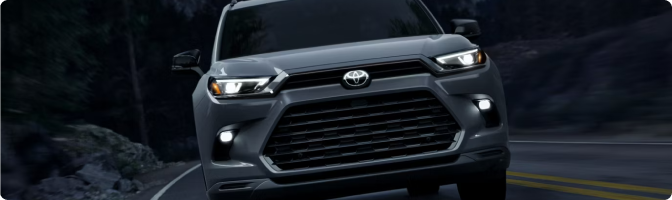
On winter, these two refuse to separate. That is worth saying plainly, because this is the part of the comparison that depends most on where you live.
Fayette County averages roughly 43 inches of snow a year down in the valley, and closer to 75 inches at the higher elevations near Chestnut Ridge. The driving here is not flat. You climb, you descend, you change elevation between the errand and the driveway. The weather up on the ridge is frequently not the weather you left forty minutes ago, and a morning that starts as rain in town can be an inch of wet snow by the time you are on the ridge road. That is why the truck-and-off-road end of our lot looks the way it does, and why all-wheel drive in Uniontown is an assumed conversation rather than an upsell.
Both SUVs deliver it, in several forms. The Grand Highlander offers Dynamic Torque Control AWD on the gas engine, Electronic On-Demand AWD on the hybrid, and full-time electronic AWD on Hybrid MAX. The Highlander's gas AWD adds Multi-Terrain Select, and the XSE grade brings sport-tuned suspension along with Dynamic Torque Vectoring AWD.
Ground clearance ties at 8 inches, so neither has a snow-depth advantage. Both have the same 265 hp and 310 lb-ft on tap for a climb out of a valley. These two are peers here. Pick on space, price and powertrain instead, because you are not trading away capability either way, and anyone who tells you the bigger one is the winter car is selling you the wrong thing.
Size is the one winter-adjacent thing that does separate them. On a snow-narrowed road with a berm down one side, four to six and a half inches of length and a couple of inches of width are things you notice. That cuts toward the Highlander, not away from it.
Safety and warranty
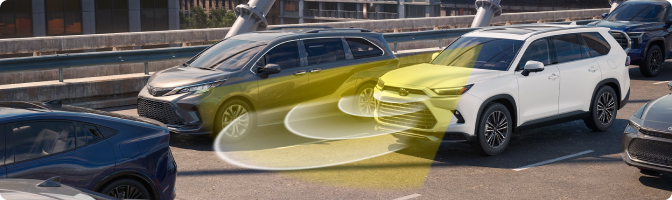
Here the Grand Highlander has a clean, named advantage. It comes standard with Toyota Safety Sense 3.0, which includes the Pre-Collision System with Pedestrian Detection, Full-Speed Range Dynamic Radar Cruise Control, Lane Departure Alert with Steering Assist, Lane Tracing Assist, Road Sign Assist, Automatic High Beams, and Proactive Driving Assist. The Highlander comes standard with Toyota Safety Sense 2.5+. That is a one-generation lead, and it is standard on every Grand Highlander grade rather than an option box on the expensive ones.
Be precise about what that means, though. It is a name-to-name comparison of two suite generations, and the newer generation is on the Grand Highlander. We will not itemize what 2.5+ leaves out, and we are not going to guess at it. If a specific feature is your reason for buying, ask us to walk you through the window sticker on the actual vehicle.
Past the suite name, the two run close together. Blind Spot Monitor with Rear Cross-Traffic Alert is standard on both. Front and Rear Parking Assist with Automatic Braking is available on both, with the Grand Highlander adding Traffic Jam Assist on its upper grades. The Panoramic View Monitor is standard on Grand Highlander Platinum and Hybrid MAX Platinum and available elsewhere on both cars. In a tight lot, it is the single feature most likely to change your mind about a bigger vehicle.
Government crash testing: both the Grand Highlander and the Highlander are rated five stars overall.
Warranty: identical, term for term.
| Coverage | Both models |
|---|---|
| Basic | 36 months / 36,000 miles |
| Powertrain | 60 months / 60,000 miles |
| Corrosion | 60 months / unlimited miles |
| Hybrid system | 96 months / 100,000 miles |
| Hybrid battery | 120 months / 150,000 miles |
If warranty is holding up your decision, it should not be. There is nothing to choose between them, including on the hybrid coverage most people assume must differ.
Grades and pricing
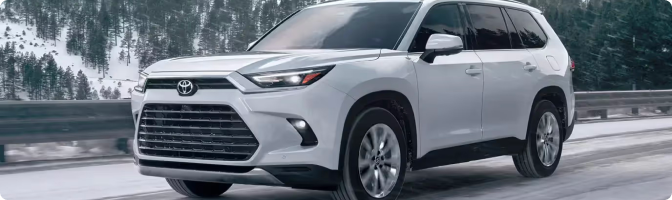
The Grand Highlander's walk is the longer one, and it runs further in both directions: it starts below the Highlander's and finishes above it. The Highlander's walk is tighter and sits in the middle.
2026 Grand Highlander, starting MSRP, excluding destination
| Grade | Drive | MSRP at Launch |
|---|---|---|
| LE | Front-wheel drive | $41,660 |
| LE | All-wheel drive | $43,260 |
| XLE | Front-wheel drive | $44,430 |
| XLE | All-wheel drive | $46,030 |
| Hybrid LE | All-wheel drive | $45,010 |
| Hybrid XLE | Front-wheel drive | $46,180 |
| Hybrid XLE | All-wheel drive | $47,780 |
| Limited | Front-wheel drive | $49,160 |
| Limited | All-wheel drive | $50,760 |
| Hybrid Limited | All-wheel drive | $52,510 |
| Hybrid Nightshade | All-wheel drive | $53,490 |
| Platinum | All-wheel drive | $54,845 |
| Hybrid MAX Limited | All-wheel drive | $55,490 |
| Hybrid MAX Platinum | All-wheel drive | $59,575 |
2026 Highlander, starting MSRP, excluding destination
| Grade | Drive | MSRP at Launch |
|---|---|---|
| XLE | All-wheel drive | $45,570 |
| Hybrid XLE | All-wheel drive | $47,320 |
| XSE | All-wheel drive | $47,640 |
| Limited | All-wheel drive | $50,025 |
| Hybrid Limited | All-wheel drive | $51,775 |
| Platinum | All-wheel drive | $53,225 |
| Hybrid Platinum | All-wheel drive | $54,975 |
About those walks: these are the 2026 grades and drivetrains our Toyota pricing information covers. They are not a statement about every configuration Toyota builds. Ask us about anything you do not see listed, and check the live listing before you assume a configuration is or is not out there.
Grades one has and the other does not: the Grand Highlander adds an LE at the bottom, a Hybrid Nightshade in the upper middle, and the two Hybrid MAX grades at the ceiling. The Highlander answers with the sport-tuned XSE and a Hybrid Platinum the Grand Highlander's walk does not match. The exclusivity runs both ways. This is not a case of the bigger car simply having more.
The entry price favors the Grand Highlander: its walk opens at $41,660 starting MSRP at launch, excluding destination, for the LE with front-wheel drive. The Highlander's walk begins at $45,570 starting MSRP at launch, excluding destination, for an XLE with all-wheel drive. On paper that is a real $3,910 difference.
But that is not a like-for-like comparison: one is a base grade with front-wheel drive, the other a mid-grade with all-wheel drive. Those two numbers tell you about the shape of the walks, not about the price of the same car twice.
Trim for trim, the Highlander is cheaper every time: line up all-wheel drive against all-wheel drive at each grade the two share, and the Highlander undercuts the Grand Highlander at every one. Not by a fortune, but consistently, and the gap widens as you climb.
| Grade, AWD to AWD | Grand Highlander | Highlander | Difference |
|---|---|---|---|
| XLE AWD | $46,030 | $45,570 | Highlander by $460 |
| Hybrid XLE AWD | $47,780 | $47,320 | Highlander by $460 |
| Limited AWD | $50,760 | $50,025 | Highlander by $735 |
| Hybrid Limited AWD | $52,510 | $51,775 | Highlander by $735 |
| Platinum AWD | $54,845 | $53,225 | Highlander by $1,620 |
All figures are starting MSRP at launch and exclude the $1,495 destination charge, which is the same on both and applies to units processed on or after January 1, 2026.
So the price story has two halves. If the lowest possible entry point is the goal, the Grand Highlander LE is the cheaper way into a Toyota three-row. If you are shopping a specific equipment level with all-wheel drive, which is what most people around here are actually doing, the Highlander undercuts the Grand Highlander at every grade the two share. Both halves are true, and either half alone is misleading.
Where the Grand Highlander wins
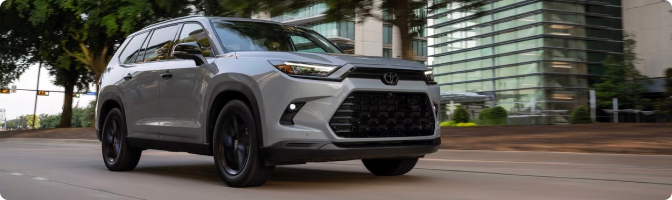
The standard Highlander gets its own section below, and it deserves it. Here is the Grand Highlander's side, gathered in one place:
- Room behind the people: 20.6 cubic feet behind the third row against 16.0, roughly 29 percent more, and 97.5 against 84.3 with everything folded. This is the reason the Grand Highlander exists, and it is the reason most families cross-shopping these two end up on this side.
- A powertrain the Highlander walk does not offer: Hybrid MAX, 362 net combined horsepower. There is no Hybrid MAX grade in the Highlander lineup at any price.
- A newer generation of driver assistance: Toyota Safety Sense 3.0 standard against 2.5+. Same family, one generation further along.
- It starts lower, which surprises people: the lowest-priced Grand Highlander opens at $41,660 at launch, excluding destination, against $45,570 for the lowest-priced Highlander. The bigger SUV is not the more expensive way in.
- A steadier stance: a 116.1-inch wheelbase against 112.2, with those extra inches between the axles rather than hung off the ends.
- More ways to configure it: ten grades in the walk against seven.
Where the standard Highlander wins
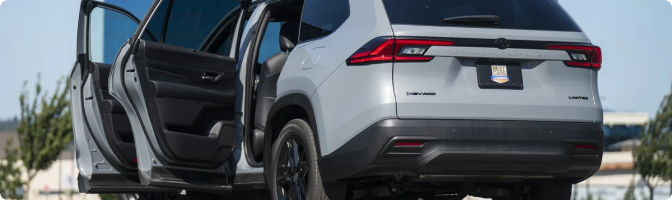
For a lot of Fayette County families, the Highlander is simply the right car. Plenty of pages about these two read like a slow argument for spending more. This one will not, and the reasons are concrete.
- It costs less at every grade you can actually match: $460 at XLE and Hybrid XLE, $735 at Limited and Hybrid Limited, $1,620 at Platinum. That money does not come back, on a car that does the same job.
- It is the smaller car to live with: four to six and a half inches shorter, roughly two inches narrower, and 3.9 inches less wheelbase. You feel that in parking decks, in older garages, on the driveway you back out of every morning, and on narrow roads with a plow berm down one side. It still has three rows. It still seats seven or eight. It is just easier to own in tight quarters, and around here a lot of quarters are tight.
- It is the more efficient one, all-wheel drive to all-wheel drive: one combined MPG on gas, one to two combined on hybrid, up to three on the highway.
- It has a grade the Grand Highlander does not: the XSE brings sport-tuned suspension and Dynamic Torque Vectoring AWD at $47,640 starting MSRP at launch, excluding destination. If you want the sharper-driving Toyota three-row, the Grand Highlander has no answer at any price.
- It has a Hybrid Platinum the other walk does not match: $54,975 starting MSRP at launch, excluding destination, for a loaded hybrid without stepping into Hybrid MAX territory.
Rarely fill the third row? Not lying awake over cargo behind row three? Would rather have the easier-to-place vehicle and the lower payment? Buy the Highlander. That is not a consolation prize. It is the same engine, the same tow rating, the same ground clearance, the same warranty and the same five-star overall government crash rating, in a package that fits your garage better and costs less.
How to shop these two in Uniontown
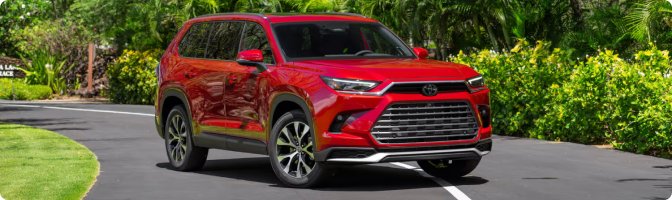
MSRP is only ever the starting line. What you finance, what you trade, and what is running that month all move the number more than the sticker gap between these two does. A $735 difference at Limited grade is smaller than most of the other variables in the deal. Worth remembering before you let it decide anything.
Current manufacturer and dealer programs are posted on our current offers page, and what is actually on the ground is on the new Toyota inventory listing. Grade availability changes constantly, so check the live list rather than assuming a configuration exists.
Financing we handle in-house, for all credit situations, including bad credit or no credit at all. Credit is only one consideration in the conversation. If that is the part you have been dreading, our page on financing with no credit walks through how it works.
Every new Toyota we sell also carries the Kelly Confidence Program. What it includes is set out on why buy from us. Mike Kelly Automotive's family-owned tradition dates to 1953.
Which one is right for you
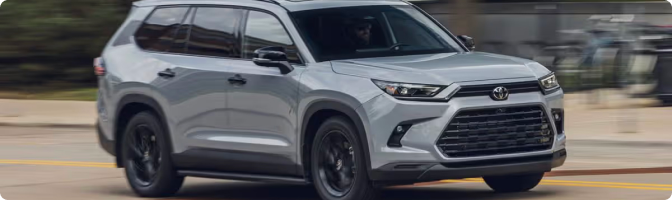
Here is the decision, reduced to the situations that actually come up on our lot. Any starting MSRP shown is at launch, excluding destination.
| Your situation | The answer | Why |
|---|---|---|
| Third row full most days, and you still need the cargo area | Grand Highlander | 20.6 vs 16.0 cu ft behind row three, a 29 percent jump |
| Third row is for occasional use | Highlander | 16.0 cu ft covers a normal week, and you keep the smaller footprint |
| Shopping a specific grade with AWD on a set budget | Highlander | Cheaper at every matching grade, by $460 to $1,620 |
| Lowest possible way into a Toyota three-row, and front-wheel drive works | Grand Highlander LE | $41,660 |
| Loading the whole family's gear for a week away | Grand Highlander | 97.5 vs 84.3 cu ft maximum, a 13.2 cu ft spread |
| You want Hybrid MAX power | Grand Highlander Hybrid MAX | 362 net combined hp / 400 net combined lb-ft, no Highlander equivalent |
| You want the sharper-driving one | Highlander XSE | Sport-tuned suspension, Dynamic Torque Vectoring AWD |
| You want the newer driver-assist generation as standard | Grand Highlander | Toyota Safety Sense 3.0 vs Toyota Safety Sense 2.5+ |
| Highway miles are most of your miles | Highlander | Up to 3 MPG better on the highway, hybrid AWD to AWD |
| Towing up to 5,000 lb | Either | Both rated 5,000 lb on the gas engine |
| Winter on the ridge | Either | Both offer AWD, both sit 8 in off the ground, both make 265 hp |
| Tight garage, narrow driveway, parking deck | Highlander | 4.0 to 6.5 in shorter, roughly 2 in narrower, 3.9 in less wheelbase |
| Warranty is the deciding factor | Either | Identical across all five terms |
Choose the Grand Highlander if:
- You carry people in the third row regularly and need cargo space at the same time. The 20.6 versus 16.0 cubic feet behind row three is the single number on this page most likely to change your mind.
- You are hauling the whole family's gear to Ohiopyle, Seven Springs or a week away, and 97.5 cubic feet of maximum cargo matters more to you than four inches of parking-space margin.
- You want Toyota Safety Sense 3.0 with Proactive Driving Assist standard on whatever grade you can afford, not just the expensive ones.
- You want Hybrid MAX, at 362 net combined horsepower and 400 net combined lb-ft. The Highlander walk has no Hybrid MAX grade, at any price.
- You want the lowest entry price into a Toyota three-row, and front-wheel drive works for you.
Choose the Highlander if:
- Your third row is for occasional use rather than every day, and 16.0 cubic feet behind it covers your normal week.
- You park in tight places. Four to six and a half inches shorter and roughly two inches narrower is felt daily, and worst in February.
- You are shopping a specific grade with all-wheel drive and want the lower price. The Highlander wins that comparison at every matching trim, by $460 to $1,620.
- Highway efficiency is a priority. Up to three MPG on the highway with the hybrid, all-wheel drive to all-wheel drive.
- You want the XSE, with its sport-tuned suspension and Dynamic Torque Vectoring AWD, or a Hybrid Platinum the other walk does not match.
This is not a good-versus-bad decision. Both are strong three-row Toyotas with identical warranties, identical five-star overall government crash ratings, the same gas engine, the same 5,000-pound tow rating, and the same eight inches of ground clearance for a Chestnut Ridge winter. It is a bigger-versus-smaller call. In our experience the smaller answer is right more often than the internet suggests, because most families overestimate how often row three is full and underestimate how often they are parking.
We are the only Toyota dealer in Fayette County, so you can drive both back to back in one stop instead of chasing them across two counties on two different afternoons. Read the full specs on the 2026 Grand Highlander and the 2026 Highlander, then come sit in row three of each at 1 Mary Jane Wood Drive.
2026 Toyota Grand Highlander vs. 2026 Toyota Highlander: Frequently Asked Questions
Is the Grand Highlander just a bigger Highlander?
Broadly yes, but the specifics matter. It is 4.0 to 6.5 inches longer with 3.9 more inches of wheelbase, and it carries 4.6 more cubic feet behind the third row and 13.2 more at maximum. It also gets two things the Highlander does not: Toyota Safety Sense 3.0 as standard, and the Hybrid MAX powertrain. The gas engine, seating capacity, tow rating, ground clearance, warranty and overall government crash rating are the same on both.
Which one seats more people?
Neither. Both the 2026 Grand Highlander and the 2026 Highlander seat seven or eight depending on the second-row configuration. The difference is not how many seats there are. It is how much room is left behind them.
Which one tows more?
Neither. Both are rated up to 5,000 pounds with the gas engine, and the Grand Highlander's Hybrid MAX is also rated at 5,000 pounds. If towing is your deciding factor, it does not decide this one.
Which gets better gas mileage?
All-wheel drive to all-wheel drive, the Highlander. On gas it is 21/28/24 against 21/27/23 for the Grand Highlander LE and XLE, and against 20/26/22 for Grand Highlander Limited and Platinum. On hybrid it is 35/35/35 against 36/32/34, so the Grand Highlander takes city by one and the Highlander takes highway by three. The margins are small either way.
How much more does the Grand Highlander cost?
It depends entirely on which two cars you line up. Trim for trim with all-wheel drive, the Grand Highlander costs more: $460 at XLE and Hybrid XLE, $735 at Limited and Hybrid Limited, $1,620 at Platinum. But its walk starts lower, at $41,660 starting MSRP at launch, excluding destination, for an LE with front-wheel drive, against $45,570 for the lowest-priced Highlander, an XLE with all-wheel drive. Both halves are true. Destination is $1,495 on both.
Is all-wheel drive worth it around Uniontown?
That is your call, but the conditions are what they are: roughly 43 inches of snow a year in the valley and around 75 inches at the higher elevations near Chestnut Ridge, on hilly, elevation-variable roads. Both SUVs offer all-wheel drive, and both sit 8 inches off the ground, so this question does not separate them. It just tends to shape which configuration people around here order.
Which one has more third-row legroom?
The Grand Highlander has the longer wheelbase, 116.1 inches against 112.2, and more cargo room behind row three. We are not putting a per-row legroom figure on this page for either SUV, so we are not going to guess at it. Sit in both. That is a five-minute answer, and it is the right one.
What is Hybrid MAX, and do I need it?
Hybrid MAX is a 2.4L turbo hybrid rated at 362 net combined horsepower and 400 net combined lb-ft, paired with a Direct Shift 6-speed automatic and full-time electronic all-wheel drive. It is Grand Highlander only, rated at 26/27/27 in the Limited and Platinum, and it starts at $55,490 starting MSRP at launch, excluding destination. You need it if you want that power, because no Highlander grade offers it. You do not need it to tow 5,000 pounds. The plain gas engine already does that in either vehicle.
Which grades does one have that the other does not?
The Grand Highlander adds an LE, a Hybrid Nightshade, and two Hybrid MAX grades. The Highlander adds the XSE, with sport-tuned suspension and Dynamic Torque Vectoring AWD, plus a Hybrid Platinum. Each walk has grades the other cannot match.
Do they have the same warranty?
Yes, term for term: 36 months / 36,000 miles basic, 60 months / 60,000 miles powertrain, 60 months / unlimited miles corrosion, 96 months / 100,000 miles on the hybrid system, and 120 months / 150,000 miles on the hybrid battery.
Can I see both at your dealership?
Yes. We are the only Toyota dealer in Fayette County, so both are on one lot at 1 Mary Jane Wood Drive in Uniontown. Check the live new-vehicle listings for grades and configurations currently available before you make the drive.